CPA vs ROAS Explained
Imagine running two ad campaigns. One gets you customers at a low cost, while the other generates massive revenue — but costs more per customer. Which campaign is actually better? The answer lies in understanding two of the most important marketing metrics: CPA and ROAS.
Marketers often confuse these two metrics — or worse, optimize for only one while ignoring the other. In this CPA vs ROAS explained guide, we’ll break down what each metric means, when to use them, and how to balance both for smarter, more profitable advertising decisions.
What is CPA? (Cost Per Acquisition)
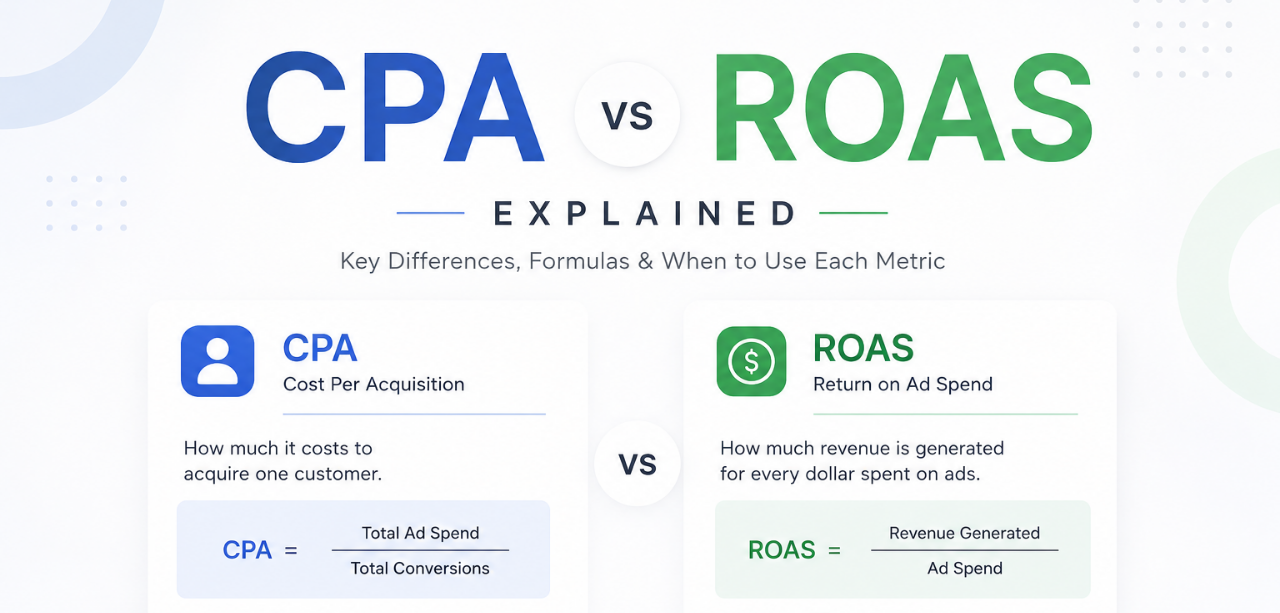
CPA, or Cost Per Acquisition, measures how much it costs your business to acquire one customer or conversion. It tells you the price you pay every time someone completes a desired action — whether that’s making a purchase, signing up for a trial, installing an app, or submitting a lead form.
CPA Formula
CPA = Total Ad Spend ÷ Total Conversions
Example: If you spend $1,000 on ads and acquire 50 customers, your CPA is $20.
Why does CPA matter?
A lower CPA generally means you are acquiring customers more efficiently. However, as we’ll explore later, cheap isn’t always better — it depends on how much those customers are worth to your business.
Industries and use cases that focus heavily on CPA:
- Lead generation campaigns (collecting qualified inquiries)
- Mobile app installs (paid user acquisition)
- Subscription businesses (SaaS free trial sign-ups)
- E-commerce customer acquisition (first-time buyers)
- Building email lists and marketing audiences
What is ROAS? (Return on Ad Spend)
ROAS, or Return on Ad Spend, measures how much revenue is generated for every dollar you spend on advertising. It is one of the clearest indicators of whether your ad campaigns are profitable from a revenue standpoint.
ROAS Formula
ROAS = Revenue Generated ÷ Ad Spend
Example: If you generate $10,000 in revenue from a $2,000 ad campaign, your ROAS is 5x — meaning every $1 spent on advertising returns $5 in revenue.
Why does ROAS matter?
A higher ROAS means your advertising dollars are working harder for you. It is especially critical for revenue-focused businesses where the goal is to scale profitably.
ROAS is the go-to metric for:
- E-commerce stores (product-level campaign optimization)
- Retail and direct-to-consumer (DTC) brands
- SaaS upsells and expansion revenue campaigns
- Holiday and seasonal promotions
- Retargeting campaigns targeting high-intent audiences
CPA vs ROAS: The Key Differences
While both metrics help evaluate advertising performance, they measure fundamentally different things. Here is a clear comparison:
| Factor | CPA | ROAS |
| Measures | Cost per customer acquired | Revenue per dollar spent |
| Goal | Lower is better | Higher is better |
| Focus | Acquiring customers | Generating revenue |
| Formula | Spend ÷ Conversions | Revenue ÷ Spend |
| Best For | Lead generation, SaaS, apps | E-commerce, retail, DTC |
| Optimization | Reduce acquisition costs | Maximize ad returns |
In short: CPA tells you how efficiently you are acquiring customers, while ROAS tells you how effectively your spending translates into revenue. Neither metric alone gives you the complete picture.
Can a Campaign Have Low CPA but Poor ROAS?
Yes — and this is one of the most common traps marketers fall into. A low CPA might look great on paper, but it doesn’t always mean your campaign is profitable.
Consider this real-world example:
Campaign A: CPA = $10 | Average Order Value = $15 | Gross Margin ≈ $5
Campaign B: CPA = $30 | Average Order Value = $200 | Gross Margin ≈ $170
Campaign A has a much lower CPA, but Campaign B is far more profitable. The customer acquired for $30 generates $200 in revenue, while the $10 customer barely breaks even after product and overhead costs.
This example shows why marketers should never optimize for a single metric in isolation. CPA and ROAS need to be evaluated together — alongside customer lifetime value, profit margins, and average order value.
When Should You Focus on CPA?
CPA is the right metric to prioritize when your primary goal is growing your customer base or user pool efficiently. It makes the most sense in scenarios where you are:
- Building brand awareness and entering new markets
- Driving app installs or platform sign-ups at scale
- Acquiring leads for a B2B or high-consideration sales process
- Offering SaaS free trials where long-term LTV matters more than initial revenue
- Expanding into new audience segments with untested creatives
In these situations, the immediate transaction value may be low or nonexistent, but the long-term value of acquiring the right customer justifies the cost. CPA keeps your acquisition efficiency in check without over-indexing on short-term revenue.
When Should You Focus on ROAS?
ROAS becomes the dominant metric when your goal is maximizing revenue from ad spend — particularly in contexts where the transaction happens quickly and is directly attributable to the ad.
- E-commerce stores running product-based campaigns
- Holiday and peak-season campaigns with high transaction volume
- Scaling campaigns that are already profitable
- Retargeting audiences who have shown purchase intent
- Product launches where revenue velocity matters
For these businesses, ROAS determines whether scaling a campaign will be profitable or will burn budget. A ROAS of 3x or higher is often considered a healthy benchmark, though this varies significantly by industry and margin structure.
Why Smart Marketers Track Both Metrics
The most effective advertisers don’t choose between CPA and ROAS — they use both metrics together to build a complete picture of campaign health. Here is why:
- Customer Lifetime Value (CLV): A high CPA may be justified if customers return repeatedly. Tracking ROAS alongside CLV reveals true profitability over time.
- Profit Margins: High ROAS doesn’t always mean high profit. A $10,000 revenue campaign with thin margins could be less profitable than a $3,000 campaign with strong margins.
- Conversion Rates: A rising CPA with stable ROAS may indicate conversion rate issues on landing pages or in the funnel.
- Average Order Value: Improving AOV through bundles or upsells can increase ROAS without touching CPA.
- Repeat Purchases: Brands with strong retention can afford a higher CPA because repeat buyers improve overall ROAS over time.
In short: CPA tells you the cost of entry; ROAS tells you the return on that investment. Together, they help you build advertising strategies that are both scalable and sustainable.
Common Mistakes Marketers Make
Chasing the Lowest CPA
Reducing CPA at all costs often means targeting audiences who convert cheaply but have low spending power or intent. These customers rarely become loyal, high-value buyers.
Ignoring Customer Lifetime Value
A high CPA for the right customer — one who purchases repeatedly or refers others — can be one of the best investments a business makes. Ignoring LTV leads to short-sighted campaign decisions.
Focusing Only on Revenue
A high ROAS with razor-thin margins is a losing strategy. Always factor in gross margin, fulfillment costs, and returns when evaluating ROAS performance.
Not Testing Ad Creatives
Poor creative is one of the biggest drivers of inefficiency in digital advertising. Weak visuals and copy increase CPA and reduce ROAS. Continuous creative testing is non-negotiable.
Ignoring Audience Segmentation
Different audiences behave differently. A blanket campaign targeting broad audiences will deliver inconsistent CPA and ROAS results. Segmenting by intent, behavior, and demographics dramatically improves both metrics.
How AI Can Improve CPA and ROAS
Artificial intelligence is fundamentally transforming the way advertisers optimize their campaigns. AI-powered tools can identify patterns across massive datasets that would be impossible for human analysts to detect manually.
Key ways AI improves advertising performance:
- Smarter audience targeting through predictive behavioral modeling
- Automated A/B testing of creatives, headlines, and CTAs at scale
- Dynamic budget allocation across platforms and campaigns in real time
- Performance forecasting that predicts CPA and ROAS before budget is committed
- Creative optimization that surfaces top-performing visual and copy combinations
- Real-time campaign adjustments based on live performance signals
Modern AI-powered advertising platforms like Dilogs AI help marketers create high-performing ad creatives faster while significantly reducing production costs. By generating engaging video and display ads at scale, businesses can improve campaign efficiency — potentially lowering CPA and increasing ROAS through better-performing creatives that resonate with the right audiences.
Tips to Lower CPA and Increase ROAS
Improve Landing Pages
A high-converting landing page directly lowers CPA. Ensure your page has a clear headline, compelling offer, social proof, and a strong call to action aligned with your ad creative.
Use Better Ad Creatives
Creative quality is one of the most impactful levers in paid advertising. Test multiple formats, hooks, and visuals — tools like Dilogs AI make it easier to produce diverse, high-quality creatives at scale.
Retarget Existing Visitors
Warm audiences convert at a much lower CPA and generate higher ROAS. Set up retargeting campaigns for website visitors, video viewers, and past purchasers to capture high-intent traffic.
Optimize Audience Targeting
Narrow your audience to those most likely to convert at your target CPA. Use lookalike audiences, behavioral targeting, and first-party data to improve signal quality.
Test Multiple Ad Variations
Never rely on a single creative or copy combination. Run structured tests across headlines, images, CTAs, and formats to continuously improve campaign performance.
Increase Average Order Value
Higher AOV directly improves ROAS without changing ad spend. Use upsells, cross-sells, product bundles, and minimum order thresholds to maximize revenue per customer.
Use AI for Creative Generation
Leverage platforms like Dilogs AI to generate and test optimized advertising creatives quickly, enabling faster iteration and better-performing campaigns at lower cost.
CPA vs ROAS: Which Metric Should You Choose?
The answer depends on your business stage, goals, and campaign type.
Choose CPA as your primary metric when:
- You are focused on growing your customer base
- You are running lead generation or user acquisition campaigns
- You are driving app installs or free trial sign-ups
- You are entering a new market or testing a new audience
Choose ROAS as your primary metric when:
- You want to maximize revenue from your ad spend
- You are scaling a profitable e-commerce operation
- You are running retargeting or high-intent campaigns
- You need to demonstrate advertising ROI to stakeholders
The best answer? Track both. The most successful digital advertising strategies use CPA to control acquisition efficiency and ROAS to ensure those acquisitions generate meaningful revenue returns.
Conclusion
CPA and ROAS are not competing metrics — they are complementary lenses that together reveal the full story of your advertising performance. CPA helps businesses understand how efficiently they are acquiring customers, while ROAS measures how effectively that spend translates into revenue.
Companies that balance both metrics — accounting for customer lifetime value, profit margins, and conversion quality — make smarter advertising decisions and build more profitable marketing strategies over time.
As AI continues to reshape digital advertising, platforms like Dilogs AI enable businesses to create smarter, data-driven ad campaigns with optimized creatives that support both lower acquisition costs and stronger advertising returns.
The marketers who win in today’s competitive landscape are those who let data guide their decisions, test relentlessly, and leverage AI tools to stay ahead. Start tracking CPA and ROAS together — and watch your campaigns reach a new level of performance.
Frequently Asked Questions (FAQ)
Q1: What is CPA in marketing?
Ans: CPA (Cost Per Acquisition) is a marketing metric that measures how much it costs to acquire one customer or conversion. It is calculated by dividing total ad spend by the number of conversions: CPA = Ad Spend ÷ Conversions.
Q2: What is a good ROAS?
Ans: A good ROAS varies by industry and margin structure. A ROAS of 3x to 5x is commonly considered strong for e-commerce — meaning every $1 spent returns $3 to $5 in revenue. High-margin businesses may target 3x, while low-margin retailers may need 6x or higher to remain profitable.
Q3: Is lower CPA always better?
Ans: Not necessarily. A lower CPA means you are acquiring customers more cheaply, but those customers may have lower order values or lifetime value. A higher CPA for a loyal, high-spending customer can be far more profitable over time. Always evaluate CPA in the context of customer quality and lifetime value.
Q4: Can you have a high ROAS and high CPA?
Ans: Yes. A campaign can have a high ROAS and a high CPA if each customer acquired is generating substantial revenue. For example, a $100 CPA paired with a $1,000 average order value is excellent business. The two metrics measure different things and often need to be balanced based on your business model.
Q5: Should businesses track CPA and ROAS together?
Ans: Absolutely. CPA and ROAS complement each other. CPA tells you how efficiently you are acquiring customers; ROAS tells you how profitable those customers are. Tracking both gives you a complete view of campaign performance and helps you make more informed advertising decisions.
Other top blogs
Related Articles
Continue your learning journey with these related insights
10 Best Omni Channel Retail Solutions for Performance Marketers
Introduction Think about the last time you browsed a product on your phone, added it to your cart on a laptop, and then picked it up in-store. That seamless experience didn’t happen by accident — it was powered by omni channel retail solutions working behind the scenes. For performance marketers in 2026, this isn’t optional […]

Real-Time Marketing in 2026: Strategy, Tools, and Implementation Guide
73% of consumers expect brands to understand their needs before they even reach out. In 2026, meeting that expectation means showing up at the right moment, on the right channel, with the right message, not hours later, but right now. Real-time marketing is the practice of responding to live events, customer behaviors, and trending moments […]
Ready to Transform Your Advertising Strategy?
Join thousands of advertisers who trust Performoo to optimize their campaigns and maximize revenue.