Real-Time Marketing in 2026: Strategy, Tools, and Implementation Guide
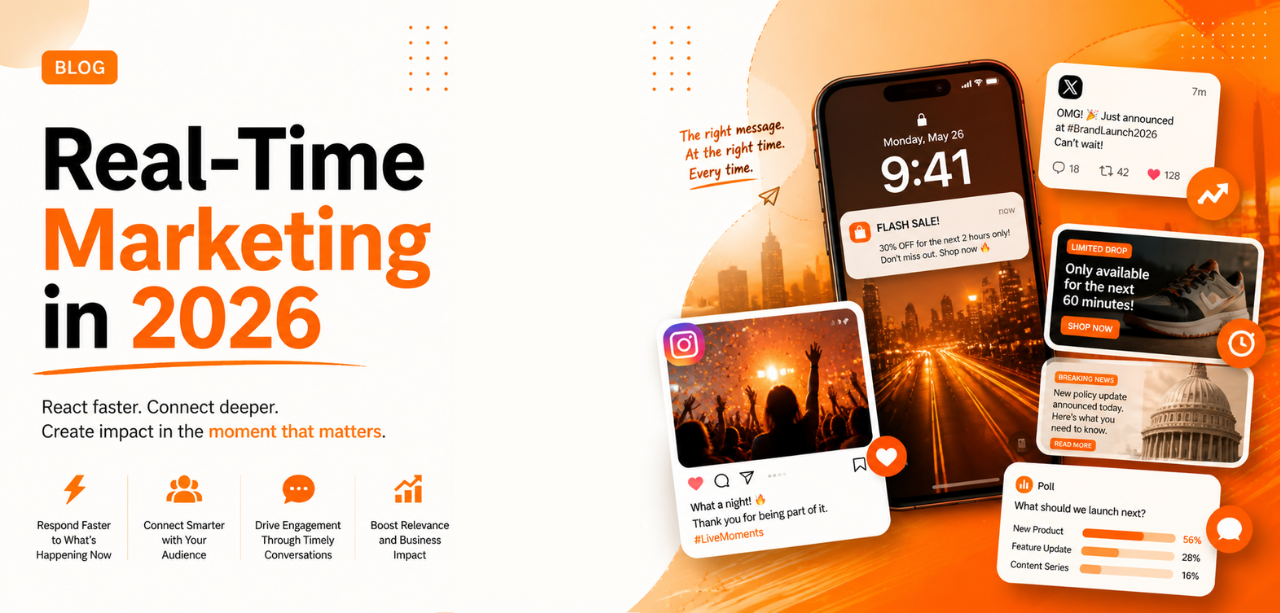
73% of consumers expect brands to understand their needs before they even reach out. In 2026, meeting that expectation means showing up at the right moment, on the right channel, with the right message, not hours later, but right now.
Real-time marketing is the practice of responding to live events, customer behaviors, and trending moments with relevant content and messaging as they unfold. It’s the difference between a brand that feels present and one that feels outdated. With AI tools maturing and consumer attention spans shrinking, real-time marketing in 2026 is no longer optional; it’s the baseline for staying competitive.
What Is Real-Time Marketing?
Real-time marketing means acting on live signals as they happen: a trending topic, a cart abandonment, a customer opening an email at midnight. Unlike traditional marketing, which is planned weeks using historical data, real-time marketing is dynamic and data-driven, built to respond to the current moment.
Its three defining characteristics are speed (responses go live within minutes), relevance (content ties to what’s happening right now), and personalization (messages adapt to each individual’s behavior and context).
Why Real-Time Marketing Matters in 2026
Consumer attention windows have shrunk to under 8 seconds on a scrolling feed. People expect instant, personalized experiences, and brands that can’t deliver them become invisible. At the same time, AI has made real-time execution accessible to businesses of every size. What once required a large marketing team and a full production cycle now takes minutes with the right tools.
The numbers back it up: brands using real-time marketing strategy see 3–5x higher engagement and up to a 40% improvement in conversions compared to static campaigns. In a crowded market, that gap is the difference between leading and lagging.
“The brand that shows up in the moment wins the moment. Real-time marketing isn’t just faster, it’s smarter.”
Core Strategies for Real-Time Marketing
- Social Listening and Trend Tracking: Use AI-powered tools to monitor conversations and trending topics around the clock. When a relevant moment surfaces, you often have a 15–60 minute window to act before it passes.
- Personalized Content Delivery: Serve dynamic content based on each user’s live browsing behavior, purchase signals, and preferences. A static homepage in 2026 is a missed opportunity.
- Moment Marketing: Map your content calendar to live events, sports, award shows, product launches, and prepare modular creative assets in advance so your team can publish in minutes, not hours.
- Omnichannel Engagement: Coordinate across social, email, push, and web so a customer experiences a seamless, real-time journey, not disconnected messages on different channels.
- Data-Driven Optimization: Replace weekly reviews with live dashboards. Set automated alerts that pause underperforming content and amplify what’s working in real time.
Top Tools for Real-Time Marketing in 2026
AI Analytics Platforms
Tools like Google Analytics 5 and Adobe Sensei provide live behavioral tracking and predictive scoring, automatically shifting budget toward your best-performing audiences without manual input.
Social Media Monitoring
Brandwatch and Sprout Social AI track brand sentiment and trending hashtags across platforms in real time, with AI relevance scoring to help you decide which moments are actually worth engaging with.
CRM and Automation
HubSpot AI and Salesforce Einstein trigger personalized workflows the instant a customer behavior occurs, sending a tailored offer within minutes of a high-intent signal rather than hours later.
AI Content Creation
Tools like Claude API and Jasper generate on-brand reactive copy and social posts in seconds. Feed in a live event, get ten post options in under a minute — content speed is no longer a bottleneck.
Step-by-Step Implementation Guide
Step 1 — Set Clear Goals: Define what real-time marketing looks like for your business. Set measurable KPIs, response time targets, engagement benchmarks, and conversion goals before you build anything.
Step 2 — Choose the Right Tools: Audit your current stack and fill the gaps with a social listening tool, CRM automation, AI content assistant, and live analytics dashboard that all integrate natively.
Step 3 — Build a Responsive Team: Designate a small rapid-response pod — a writer, designer, and one approver. Pre-approve brand voice guidelines and templates so the approval chain never becomes the bottleneck.
Step 4 — Monitor in Real Time: Set up a unified dashboard combining social feeds, Google Trends alerts, and behavioral data. Use AI to score and filter signals so your team only acts on what’s truly relevant.
Step 5 — Execute and Optimize: Publish fast, then improve faster. Run A/B tests with hour-long learning windows. Log what worked after every real-time campaign moment and feed those insights back into your next response.
Real-World Examples
Oreo’s “Dunk in the Dark”: When the Super Bowl suffered a power outage, Oreo’s team published a single image, “Power out? No problem. You can still dunk in the dark” within minutes. It earned 15,000+ retweets. The secret wasn’t quick thinking; it was a pre-assembled team with pre-approved creative freedom already in place.
Amazon’s Personalization Engine: Amazon processes over a billion data points per hour to serve each visitor a unique homepage in real time. That one capability drives an estimated 35% of total revenue, making it the clearest proof that real-time personalization pays.
Nike’s Live Event Drops: Nike monitors athlete performance in real time and releases limited merchandise within minutes of major sporting moments. Pre-built assets and a trigger protocol mean the campaign goes live before the news cycle peaks.
Challenges and How to Overcome Them
Risk of mistakes: Speed increases the chance of tone-deaf posts or errors. Solve this with a one-person approval layer, pre-defined no-go topics, and AI content filters that flag sensitive language before publishing.
Data overload: Too many signals can cause paralysis. Use AI to prioritize only the most relevant alerts, and set clear thresholds, so your team acts with purpose — not panic.
Future Trends in Real-Time Marketing
The next wave of marketing trends in 2026 points toward AI-generated content at scale, thousands of personalized variants created hourly, and predictive marketing, where brands anticipate trends before they surface rather than reacting after. Hyper-personalization will render every touchpoint uniquely for each user based on real-time intent, location, and context. Generic messaging won’t just underperform; it will actively push audiences away.
Conclusion
Real-time marketing in 2026 is the strategy that separates brands that grow from those that stall. Consumers expect instant, relevant, personalized experiences, and the tools to deliver them have never been more accessible.
You don’t need a massive budget to start. You need a clear goal, the right tools, an empowered team, and the discipline to act before the moment passes. Start small, move fast, and keep optimizing. The opportunity is live right now, the only question is whether your brand will show up for it.
Other top blogs
Related Articles
Continue your learning journey with these related insights
10 Best Omni Channel Retail Solutions for Performance Marketers
Introduction Think about the last time you browsed a product on your phone, added it to your cart on a laptop, and then picked it up in-store. That seamless experience didn’t happen by accident — it was powered by omni channel retail solutions working behind the scenes. For performance marketers in 2026, this isn’t optional […]
SEO vs PPC: Which Strategy Drives Better Growth in 2026?
The digital landscape for US businesses has never been more competitive. As we navigate 2026, the traditional battle of SEO vs PPC has evolved into a sophisticated game of data and intent. Whether you are a SaaS founder in Austin or an e-commerce giant in New York, choosing the right seo and ppc management strategy […]
Ready to Transform Your Advertising Strategy?
Join thousands of advertisers who trust Performoo to optimize their campaigns and maximize revenue.