What Is an Insertion Order? A Complete Guide for Modern Advertising and Marketing Teams
In the fast-paced world of digital marketing, where millions of ads are bought and sold in milliseconds via algorithms, it’s easy to think that "handshake deals" have gone entirely digital. But when you’re moving significant budgets—whether it’s a $5,000 localized campaign or a $500,000 national takeover—you need more than just a "settings saved" notification. You need an insertion order.
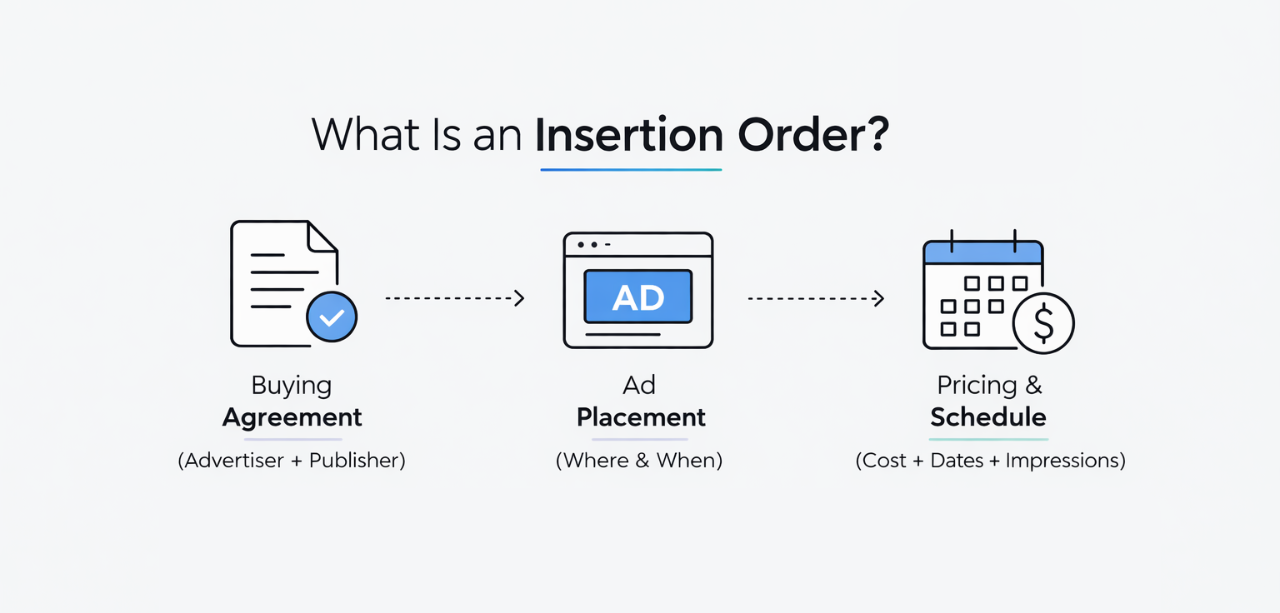
An insertion order (IO) is the final step in the ad-buying process. It represents the formal agreement between an advertiser (or their agency) and a publisher (the website or platform running the ads). Think of it as the "bill of sale" for the advertising world. It ensures that both parties are on the same page before a single cent is spent or a single pixel is loaded.
What Exactly Is an Insertion Order?
At its core, an insertion order is a legally binding document that outlines the specific details of an advertisement's placement. It’s the "who, what, when, and how much" of a marketing campaign.
Snippet-Ready Definition: An insertion order (IO) is a formal contract between an advertiser and a publisher that specifies the dates, dimensions, pricing, and placement of an advertising campaign. It serves as the official commitment to run an ad.
While programmatic advertising has automated much of this, IOs are still the backbone of direct buys, sponsorship deals, and premium placements where certainty and human oversight are required.
Why Do Marketing Teams Still Use Insertion Orders?
You might wonder, "If I can just put a credit card into Facebook or Google Ads, why do I need a formal document?"
In the agency world and for high-growth startups, IOs provide a level of protection that "self-serve" platforms don't always offer.
- Financial Accountability: It creates a paper trail for accounting departments to track committed spend versus actual spend.
- Legal Protection: If a publisher fails to deliver the promised number of impressions, the IO is your legal leverage for a "make-good" (free additional ad space).
- Clarity on Deliverables: It prevents "scope creep" or misunderstandings about where an ad will appear (e.g., "above the fold" vs. buried in the footer).
Key Elements of a Standard Insertion Order
A professional IO isn't just a memo; it’s a structured document. If you are building one for the first time, ensure it includes these essential components:
- Campaign Name and Dates: The start and end dates (flight dates) of the campaign.
- Ad Placements: Specific areas of a site or app where the ad will live (e.g., Homepage Banner, Newsletter Sponsorship).
- Dimensions and Formats: The physical size of the creative (e.g., 728x90 leaderboard) and the file type.
- Targeting Criteria: Details on the intended audience, such as geographic location or specific interests.
- Pricing Model: Is it CPM (Cost Per Mille/1,000 impressions), CPC (Cost Per Click), or a Flat Fee?
- Total Cost: The maximum budget committed to this specific order.
- Reporting and Tracking: Which party's numbers will be used for billing? (Usually, the advertiser's third-party ad server is the "source of truth").
How the Insertion Order Process Works Step-by-Step
If you’re new to a media buying team, the workflow usually looks like this:
1. The Media Plan
The advertiser or agency identifies a publisher they want to work with. They negotiate rates and placements based on a media plan.
2. The Proposal (RFP)
The publisher sends over a proposal or a "media kit" showing what they have available.
3. Drafting the IO
Once terms are agreed upon verbally or via email, the advertiser (or the publisher) drafts the insertion order. In most agency workflows, the agency drafts the IO to ensure their specific legal "boilerplate" language is included.
4. Signing and Counter-signing
Both parties sign the document. In the modern era, tools like DocuSign or PandaDoc have replaced the old fax-and-scan method.
5. Campaign Execution
The ads go live. Throughout the flight, the agency monitors the publisher's performance against the specs in the IO.
Insertion Order vs. Contract vs. Purchase Order: What’s the Difference?
These terms are often used interchangeably, but they serve different roles in a business ecosystem.
| Feature | Insertion Order (IO) | Purchase Order (PO) | Master Service Agreement (MSA) |
|---|---|---|---|
| Primary Purpose | Specifics of an ad placement. | General authorization of funds. | Long-term legal framework. |
| Who Issues It? | Advertiser/Agency. | Finance Department. | Legal Department. |
| Frequency | Per campaign or monthly. | Per fiscal quarter/year. | Once (updated rarely). |
An MSA (Contract) governs the relationship, the PO reserves the money in the company budget, and the IO tells the publisher exactly which ads to run.
The Benefits of Using IOs for Advertisers and Publishers
For Advertisers:
- Budget Control: You won't get a "surprise bill" because the IO caps the spend.
- Quality Assurance: You can stipulate "brand safety" requirements (e.g., your ad shouldn't appear next to controversial content).
For Publishers:
- Guaranteed Revenue: It allows publishers to forecast their income and "reserve" inventory so they don't oversell their space.
- Payment Recourse: If an advertiser refuses to pay, the signed IO is the primary evidence used to collect debt.
Common Mistakes Marketers Make with Insertion Orders
Even experienced media buyers can trip up. Watch out for these pitfalls:
- Vague "Make-Good" Clauses: If the publisher misses their impression goal, what happens? Be specific about how you’ll be compensated.
- Ignoring Technical Specs: Sending a 300x250 ad when the IO called for a 300x600 can delay a campaign by days.
- Wrong Billing Contact: Ensure the "Bill To" section is 100% accurate to avoid your ads being paused due to "non-payment" errors.
The Role of IOs in the Age of Programmatic Advertising
Is the insertion order dead? Not even close.
While Programmatic Guaranteed (PG) buys allow for automated execution, many premium publishers still require a "Letter of Intent" or a simplified IO before opening their private marketplaces (PMPs). In influencer marketing—one of the fastest-growing sectors—the IO is the primary way to manage "whitelisting" and content usage rights.
Future Trends: Where Are Advertising Agreements Heading?
We are moving toward Smart Contracts. As blockchain technology matures, we may see insertion orders that automatically trigger payments once a third-party tracker verifies that the impressions were delivered. This would eliminate the 30-to-60-day waiting period currently standard in agency billing.
Conclusion: The Final Word on Insertion Orders
Understanding the insertion order is a rite of passage for any serious marketer. It represents the transition from "playing with ads" to professional media buying. By ensuring your IOs are detailed, accurate, and signed, you protect your budget, your brand, and your professional reputation.
Whether you are a startup founder booking your first podcast sponsorship or an agency vet managing a multi-million dollar rollout, the IO remains your most reliable tool for clarity and accountability.
READ ALSO:- What Is AdTech? Everything You Need to Know
Frequently Asked Questions (FAQ)
1. Is an insertion order a legal contract?
Yes. Once signed by both the advertiser and the publisher, an insertion order is a legally binding agreement that commits the advertiser to pay and the publisher to provide the specified ad space.
2. Can I cancel an insertion order?
Most IOs include a cancellation clause. Standard industry practice (often following IAB terms) allows for cancellation with a 14-to-30-day written notice, but you must check the specific "fine print" on your document.
3. Who usually sends the insertion order?
Typically, the advertiser or the advertising agency sends the IO to the publisher. However, some large publishers prefer to issue their own IOs for the advertiser to sign.
4. What does "Net 30" or "Net 60" mean on an IO?
These are payment terms. "Net 30" means the advertiser has 30 days to pay the invoice after the campaign or billing period ends.
5. Does programmatic advertising use insertion orders?
In "Open Auction" programmatic, no. However, in "Programmatic Direct" or "Private Marketplace" (PMP) deals, an IO or a digital version of it is often used to establish the initial terms.
Other top blogs
Related Articles
Continue your learning journey with these related insights
How Video Ad Networks and Programmatic Video Ads Work Together
Publishers spend hours trying to fill ad slots only to watch fill rates and CPMs disappoint them, while advertisers wonder why their video creative keeps reachi

How to Scale Your Business Using Performoo’s automation
Growing a business is exciting but doing it manually is exhausting. As your campaigns multiply, your ad spend increases, and your customer base expands, the old

All you need to know about the revenue chart
Introduction Every business wants to grow. But wanting growth and actually measuring it are two very different things. That's where a revenue growth chart comes
Ready to Transform Your Advertising Strategy?
Join thousands of advertisers who trust Performoo to optimize their campaigns and maximize revenue.