What Is a Video Ad Server: Complete Guide for 2026
Introduction
Video advertising has become one of the most powerful channels in the modern marketer’s toolkit. By 2026, digital video ad spend is projected to surpass $100 billion globally, driven by explosive growth in mobile video consumption, connected TV (CTV) viewership, and programmatic video inventory across streaming platforms.
But with opportunity comes complexity. Advertisers today are managing campaigns across a fragmented ecosystem — websites, apps, YouTube, CTV, social platforms, and programmatic exchanges — each with its own tracking, reporting, and optimization requirements. The result is a common set of pain points:
- Fragmented campaign management across multiple platforms
- Inconsistent tracking and performance visibility
- Difficulty testing and rotating video creatives at scale
- Budget wasted on low-performing placements and audiences
- Limited ability to optimize campaigns in real time
This is where a video ad server becomes essential. Rather than juggling disconnected tools, advertisers can use a single platform to deliver, manage, track, and optimize all their video campaigns — and gain the unified visibility needed to make smarter decisions.
What Is a Video Ad Server?
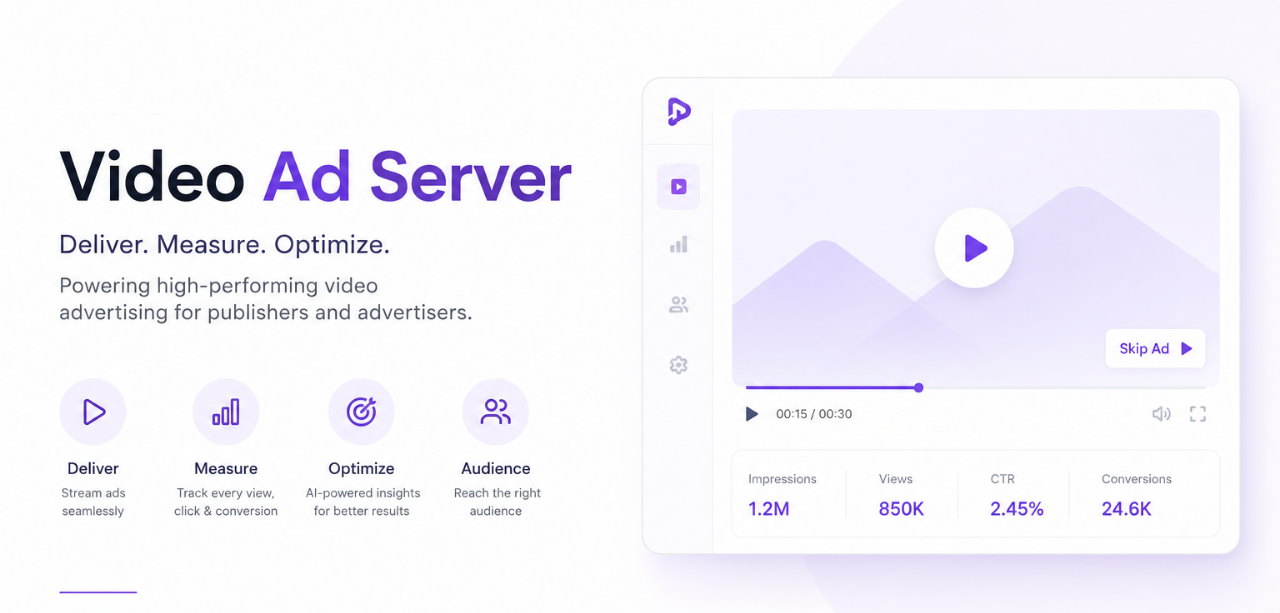
A video ad server is a technology platform that automates the delivery and management of video advertisements to digital audiences. At its core, it sits between an advertiser’s video creative assets and the publisher environments where those ads appear — handling the logistics of which ad is served to which user, at what time, on which device.
Modern video ad servers go far beyond basic delivery. They provide:
- Ad Delivery: Serving the right video creative to the right audience across multiple channels and environments simultaneously.
- Creative Management: Storing, organizing, and rotating video ad assets to support A/B testing and multi-variant campaigns.
- Audience Targeting: Reaching users based on demographics, interests, behaviors, geolocation, and device type.
- Campaign Tracking: Capturing granular data on impressions, views, view-through rates, clicks, and conversions.
- Performance Reporting: Providing dashboards and analytics that translate raw data into actionable insights.
In short, a video ad server replaces the chaos of manual campaign management with a structured, data-driven system that helps advertisers work smarter — not just harder.
Why Advertisers Need a Video Ad Server
Without the right infrastructure, video advertising often fails to deliver its potential. Here are three critical problems that a video ad server directly addresses:
1. Poor Campaign Visibility
Advertisers running campaigns across multiple channels often struggle to get a clear picture of performance. They cannot easily determine which placements are delivering value, which creative variations are resonating, or which audience segments are converting — making informed optimization nearly impossible.
2. Inefficient Budget Allocation
Without accurate tracking and attribution, marketing budgets are frequently misdirected. Low-performing placements continue to receive spend while high-performing opportunities are underinvested. Over time, this compounds into significant ROI loss.
3. Limited Optimization Capability
Successful video advertising requires continuous testing and refinement. Advertisers who lack real-time performance data are always reacting too late — adjusting campaigns based on yesterday’s results rather than today’s signals.
Key Benefits of Using a Video Ad Server
Better Campaign Control
Manage all video campaigns from a single, unified platform. Instead of logging into multiple tools, advertisers can view, adjust, and optimize every campaign element from one dashboard — saving time and reducing the risk of errors.
Real-Time Performance Tracking
Monitor the metrics that matter most, in real time:
- Impressions and reach
- Video views and completion rates
- View-through rates (VTR)
- Click-through rates (CTR)
- Conversions and cost-per-acquisition (CPA)
Improved Audience Targeting
Reach the right users at the right time by leveraging advanced targeting parameters, including demographics, interests, behavioral signals, device types, and geolocation — reducing wasted impressions and improving engagement rates.
Higher Advertising ROI
Data-driven optimization allows advertisers to shift budget toward top-performing creatives, placements, and audience segments — continuously improving campaign efficiency and maximizing return on ad spend (ROAS).
Cross-Platform Ad Delivery
Modern video ad servers support delivery across the full digital ecosystem:
- Desktop and mobile websites
- Mobile apps (iOS and Android)
- Connected TV (CTV) and Over-the-Top (OTT) platforms
- Streaming services and digital video players
How Video Ad Servers Improve Campaign Performance: Step by Step
The performance advantage of a video ad server comes from a structured, data-driven workflow:
- Upload and organize your video creatives within the platform’s asset management system.
- Configure targeting parameters: audience segments, device types, geographic regions, and dayparting.
- Launch campaigns and begin ad delivery to your intended audiences across multiple channels simultaneously.
- Track engagement in real time: who is watching, for how long, and what actions they take after viewing.
- Analyze performance data to identify which creatives, placements, and audiences are driving the best results.
- Optimize campaigns by reallocating budget, pausing underperformers, and scaling winning combinations.
This closed-loop cycle of delivery, measurement, and optimization is what separates high-performing video campaigns from those that drain budget without results.
Essential Features Advertisers Should Look For
Not all video ad servers are created equal. When evaluating platforms, prioritize these capabilities:
Campaign Management Dashboard
A clean, intuitive interface that provides a consolidated view of all active campaigns, performance metrics, and budget pacing.
Advanced Audience Targeting
Robust targeting options including demographic, interest-based, behavioral, contextual, and retargeting capabilities — with support for first-party data integration.
Creative Performance Analytics
Side-by-side comparison of video creative variants to identify which messaging, length, and format drives the strongest engagement and conversions.
Frequency Capping
Controls that limit how often individual users see the same ad — preventing audience fatigue and protecting brand perception.
Brand Safety Controls
Tools to ensure ads only appear alongside appropriate content, protecting brand reputation and campaign integrity.
Real-Time Reporting
Live dashboards that surface actionable data as campaigns run, enabling rapid response to performance trends.
Multi-Channel Ad Delivery
Support for serving ads across web, mobile, CTV, and programmatic inventory from a single unified system.
AI-Powered Optimization
Machine learning capabilities that automate bid management, creative rotation, audience targeting refinement, and budget allocation based on real-time performance signals.
The Role of AI in Modern Video Advertising
Artificial intelligence has fundamentally changed what is possible in video campaign management. AI-powered video advertising platforms can:
- Predict which creatives are likely to perform best before campaigns fully ramp up
- Automatically identify high-value audience segments based on behavioral signals
- Optimize bids in real time to maximize ROAS across programmatic inventory
- Rotate creatives dynamically to surface the strongest performer for each audience
- Detect underperforming placements early and reallocate spend proactively
- Increase engagement rates by personalizing ad delivery at scale
For advertisers managing large budgets or complex multi-channel campaigns, AI optimization is no longer a luxury — it is a competitive necessity. Platforms without intelligent automation simply cannot match the efficiency of those that have it.
How Performoo Helps Advertisers Scale Video Campaigns
Performoo is an AI-powered advertising technology platform designed to help brands, agencies, and performance marketers manage and optimize their video advertising campaigns more effectively.
Centralized Campaign Management
Performoo brings all campaign activity into a single dashboard, eliminating the need to switch between disconnected tools and giving teams a complete view of campaign performance across channels.
Actionable Analytics
Rather than surfacing raw numbers, Performoo translates campaign data into clear, actionable insights — helping advertisers understand not just what happened, but what to do next.
Smarter Audience Targeting
Performoo’s targeting capabilities help advertisers reach the right audiences with precision — using behavioral signals, demographic data, and first-party insights to reduce wasted impressions and improve conversion rates.
Performance Optimization
The platform’s AI-driven optimization continuously improves campaign efficiency — automatically adjusting creative rotation, audience targeting, and budget allocation based on live performance data.
Scalable Advertising Infrastructure
Designed to support campaigns at scale, Performoo provides the infrastructure advertisers need to expand reach across multiple channels without proportionally increasing management complexity.
Common Mistakes Advertisers Make — and How to Avoid Them
Ignoring Creative Testing
Many advertisers launch a single video creative and leave it running indefinitely. Solution: Continuously test multiple variants — different lengths, messaging, and calls to action — and let performance data guide creative decisions.
Not Tracking Viewability Metrics
Impressions alone do not tell you whether users actually saw your ad. Solution: Monitor viewability rates, completion rates, and view-through rates alongside traditional metrics to assess true campaign quality.
Poor Audience Segmentation
Broadcasting the same ad to a broad, undifferentiated audience drives up costs and reduces relevance. Solution: Build distinct audience segments and tailor messaging to each group for higher engagement and better conversion rates.
Overexposure Through High Frequency
Showing the same ad to the same user too many times creates ad fatigue and can damage brand perception. Solution: Use frequency capping to set sensible exposure limits and maintain a positive brand experience.
Focusing Only on Impressions
Volume metrics like impressions and reach are easy to track, but do not reflect campaign quality or business impact. Solution: Tie video campaign performance to downstream outcomes — conversions, revenue, and customer lifetime value.
Future Trends in Video Advertising (2026 and Beyond)
The video advertising landscape continues to evolve rapidly. Advertisers who understand the trajectory of the industry will be better positioned to capture competitive advantage:
AI-Driven Campaign Optimization
Machine learning models will become increasingly capable at predicting performance and automating optimization decisions at a granularity that human operators cannot match.
Programmatic Video Growth
Programmatic video inventory continues to expand, giving advertisers access to premium placements across a broader range of publishers and platforms through automated buying.
Connected TV Advertising
CTV viewership is growing as audiences shift away from linear television. Advertisers who build CTV capabilities now will be positioned to reach these audiences at scale as the channel matures.
Personalized Video Experiences
Dynamic creative optimization (DCO) will enable advertisers to serve personalized video ad variations based on individual user context, dramatically improving relevance and engagement.
Cookieless Targeting Strategies
As third-party cookies continue to phase out, advertisers will rely increasingly on contextual targeting, first-party data, and privacy-preserving measurement solutions.
First-Party Data Utilization
Brands with rich first-party data assets — from CRM systems, loyalty programs, and owned digital properties — will have a significant competitive advantage in precision targeting.
Why Video Ad Servers Will Be Essential in 2026
Digital advertising has never been more competitive — or more expensive. CPMs are rising across channels, audience attention is increasingly fragmented, and the margin for inefficiency has narrowed considerably.
In this environment, the advertisers who succeed will be those who can:
- Target audiences with greater precision
- Measure performance with greater accuracy
- Optimize campaigns with greater speed
- Demonstrate clear ROI from every advertising dollar
A video ad server is not simply a convenience — it is the operational infrastructure that makes these capabilities possible. As ad costs continue to rise and competition intensifies, the gap between advertisers with mature video ad serving capabilities and those without will only widen.
KEY TAKEAWAYS
- Video ad servers centralize campaign management, reducing operational complexity and improving team efficiency.
- Real-time performance tracking gives advertisers the data they need to optimize campaigns while they are running.
- Advanced audience targeting reduces wasted spend and improves the relevance of every ad served.
- AI-powered optimization automates decisions that improve ROAS without requiring constant manual intervention.
- Cross-platform delivery capabilities ensure advertisers can reach audiences wherever they consume video content.
- Common mistakes — poor creative testing, high frequency, and impression-only measurement — are avoidable with the right platform.
- Future trends, including CTV growth, cookieless targeting, and first-party data, will reward advertisers who invest in video ad serving infrastructure now.
Conclusion
Video advertising represents one of the most significant growth opportunities in digital marketing — but capturing that opportunity requires more than great creative. It requires the infrastructure to deliver ads effectively, the analytics to measure impact accurately, and the optimization tools to improve performance continuously.
A modern video ad server provides all of these capabilities in a single, integrated platform. By centralizing campaign management, enabling real-time optimization, and supporting delivery across every major digital channel, video ad servers give advertisers the control and visibility they need to drive meaningful results.
For brands and agencies looking to raise the performance ceiling on their video campaigns, platforms like Performoo offer a purpose-built solution: centralized management, AI-powered optimization, actionable analytics, and the scalable infrastructure required to compete effectively in an increasingly complex digital landscape.
As 2026 unfolds and ad costs continue to rise, investing in the right video ad serving technology is not just a tactical decision — it is a strategic one.
FAQ SECTION
| Q: What is the difference between a video ad server and a DSP? A: A video ad server focuses on managing, delivering, and tracking your video creatives across multiple channels. A demand-side platform (DSP) is used to purchase programmatic ad inventory. The two are complementary — many advertisers use a video ad server to manage creative delivery while using a DSP for media buying. |
| Q: Do I need a video ad server if I only run campaigns on one platform? A: If you run video campaigns exclusively on a single walled-garden platform (such as YouTube or Meta), its native tools may be sufficient. However, as soon as you expand to multiple channels — websites, CTV, mobile apps, or programmatic inventory — a dedicated video ad server becomes important for unified tracking and optimization. |
| Q: How does a video ad server improve ROI? A: By providing real-time performance data, enabling creative testing, and automating optimization decisions, a video ad server ensures budget is continuously directed toward the placements, audiences, and creatives delivering the best results — reducing waste and improving return on ad spend (ROAS). |
| Q: What is frequency capping, and why does it matter? A: Frequency capping limits how many times a single user sees the same ad within a given time period. Without frequency controls, over-serving can lead to ad fatigue, negative brand sentiment, and wasted spend on users who have already been exposed. |
| Q: How does AI improve video advertising performance? A: AI analyzes campaign performance data at scale to identify patterns that human managers might miss. It can automatically optimize bidding, rotate creatives toward top performers, refine audience targeting, and flag underperforming placements — all in real time and continuously throughout a campaign. |
Other top blogs
Related Articles
Continue your learning journey with these related insights

Driving CTV Transparency and Speed with Your Ad Server
In recent years, the rise of video streaming platforms has brought new challenges in transparency and quality control. Reports from Adalytics on YouTube brand safety and from the ANA on supply chain transparency highlight the growing need for stricter standards in programmatic services. It has led CTV media owners to offer customers transparency on the […]
Top CTV Platforms and Service Providers for 2025
In 2024, the Connected Television (CTV) scene has become more significant than ever and offer marketers an array of platform choices. This article focuses on the best CTV platforms and services and explains their distinctive characteristics and advertising capabilities. If you’re seeking to improve the impact or increase the effectiveness of your advertising, this guide […]
Ready to Transform Your Advertising Strategy?
Join thousands of advertisers who trust Performoo to optimize their campaigns and maximize revenue.