Ad Spend Optimization Guide
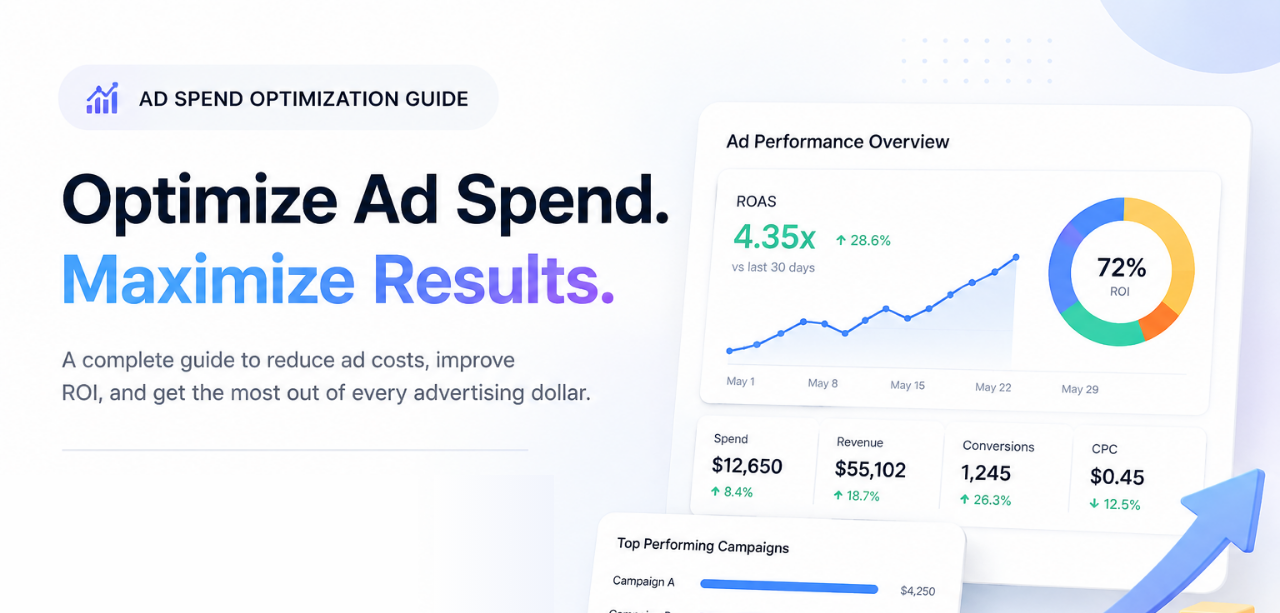
Digital ad budgets are growing — but so is the cost of wasting them. Here’s how smart businesses are getting more from every dollar they spend.
Global digital ad spend is projected to surpass $870 billion by 2026. Yet studies consistently show that businesses waste 20–40% of their advertising budgets on poorly targeted, underperforming campaigns. With rising CPCs across Google, Meta, and LinkedIn, the pressure to make every dollar count has never been higher.
This ad spend optimization guide gives you a clear, actionable framework — from defining the right metrics to leveraging AI tools like Dilogs AI — to improve your advertising ROI without simply throwing more money at underperforming campaigns.
What Is Ad Spend Optimization?
Ad spend optimization is the process of analyzing, adjusting, and improving how your advertising budget is allocated across channels, campaigns, audiences, and creatives — with the goal of maximizing return without necessarily increasing total spend.
It’s fundamentally different from simply spending more. The focus is on efficiency: getting more conversions, lower CPAs, and higher ROAS from the budget you already have.
Key Metrics to Track
ROAS (Return on Ad Spend): Revenue generated per dollar of ad spend. A ROAS of 4× means $4 returned for every $1 spent.
CTR (Click-Through Rate): The percentage of people who see your ad and click it. Signals creative relevance and audience fit.
CPC (Cost Per Click): Lower CPCs mean your budget stretches further across the funnel.
CPA (Cost Per Acquisition): The true cost of winning one customer through paid advertising.
Conversion Rate: The percentage of ad clicks that result in a desired action — purchase, signup, or lead.
Why Ad Spend Optimization Matters in 2026
Competition in digital advertising has intensified dramatically. Average CPCs on Google Search increased by over 19% year-over-year in key verticals. For startups and SMBs operating on constrained budgets, inefficiency isn’t just costly — it’s existential.
Rising customer acquisition costs, tighter marketing budgets, and increased platform competition mean businesses can no longer afford to run campaigns on autopilot. Those that optimize advertising spend grow their customer acquisition channels sustainably, while those that don’t are outbid into irrelevance.
Long-term, optimized ad programs compound: better data leads to better targeting, which reduces CPA over time, freeing up budget to scale winning campaigns further.
Common Reasons Businesses Waste Advertising Budget
- Poor audience targeting — broad targeting wastes impressions on users who will never convert
- Weak creatives — low-quality ad visuals and copy tank CTR and raise effective CPCs
- No A/B testing — running a single ad variant means leaving performance gains on the table
- Ineffective landing pages — even a great ad fails if the landing page doesn’t convert
- Broad keyword targeting — capturing irrelevant search intent drives up spend with no return
- Manual optimization delays — slow human reaction to performance shifts means budget burns before you can act
- Ignoring analytics — campaigns run without regular review drift toward poor performance unnoticed
- Poor audience segmentation — treating all users the same ignores the different intent signals across your funnel
10 Proven Ad Spend Optimization Strategies
1. Define Clear Campaign Goals
Every campaign needs a single measurable objective — awareness, leads, or purchases. Campaigns without defined KPIs can’t be optimized because there’s no benchmark to improve against. Start with the end result in mind and work backward to the metrics that matter.
2. Understand Your Target Audience
Build detailed buyer personas using demographic, behavioral, and psychographic data. Use interest-based and behavioral targeting on paid platforms, and layer in first-party data segments for precision. Narrow, well-defined audiences consistently outperform broad targeting on cost per acquisition.
3. Continuously A/B Test Ads
Test one variable at a time — headline, visual, CTA, or offer. Even a 10% lift in CTR from testing compounds significantly across thousands of impressions. Run tests long enough to reach statistical significance before drawing conclusions.
4. Improve Landing Page Experience
A landing page with poor relevance, slow load speed, or a confusing CTA will destroy conversion rate regardless of ad quality. Align your ad message and landing page tightly. A 1-second improvement in page load time can increase conversions by up to 7%.
5. Use Retargeting Campaigns
Retargeting warm audiences — people who visited your site or engaged with your content — consistently delivers higher ROAS than cold prospecting. These users already know your brand. Even a small retargeting budget can recover a significant portion of lost conversions.
6. Allocate Budget Based on Performance
Shift spend away from underperforming campaigns weekly. Use performance data to double down on ad sets delivering your best CPA or ROAS. Treat your budget like an investment portfolio — concentrate capital where returns are highest.
7. Optimize Ad Creatives Regularly
Creative fatigue is real. When ad frequency rises above 3–5 impressions per user, performance declines sharply. Rotate fresh visuals and copy consistently to maintain engagement and keep CPCs from inflating.
8. Leverage First-Party Data
With third-party cookies largely phased out, CRM-based audiences, customer match lists, and email data are among the most powerful targeting signals available. Upload your customer lists to build lookalike audiences and improve targeting accuracy across platforms.
9. Monitor Metrics in Real Time
Set automated alerts for sudden CPC spikes or CTR drops. Real-time monitoring lets you pause wasted spend within hours, not days. The faster you respond to performance shifts, the less budget you burn on campaigns that aren’t working.
10. Use AI for Advertising Optimization
AI tools automate bidding, predict audience performance, generate creative variants at scale, and surface optimization opportunities faster than any human team can manually identify. Platforms that incorporate machine learning into campaign management consistently outperform manually managed accounts on efficiency and ROI.
How AI Is Changing Ad Spend Optimization
The shift from manual campaign management to AI-powered optimization has accelerated significantly. Machine learning models can now predict which creative will resonate with which audience segment before a campaign even launches. Automated bidding systems adjust bids thousands of times per day based on real-time signals — something no human team can replicate at scale.
Key benefits of AI-powered advertising include:
- Faster decision-making — adjustments in milliseconds vs. hours
- Better audience targeting — predictive models surface high-intent segments
- Improved conversion rates — personalized creatives outperform generic variants
- Reduced wasted budget — automated rules pause poor performers instantly
- Scalable creative generation — produce hundreds of ad variants without proportional cost increases
As privacy regulations tighten and signal loss increases across platforms, AI becomes even more critical for maintaining targeting precision without relying on third-party data.
How Dilogs AI Helps Advertisers Maximize ROI
Dilogs AI is built specifically for advertisers who need to move fast without sacrificing creative quality. Rather than relying on slow, expensive creative production cycles, Dilogs AI helps marketing teams:
- Generate AI-powered ad creatives — images, copy, and video — in minutes
- Produce personalized ad content tailored to specific audience segments at scale
- Create high-converting video advertisements without large production budgets
- Reduce creative production costs significantly while improving output volume
- Accelerate campaign workflows from brief to live ad in a fraction of the usual time
- Improve audience engagement through data-driven creative optimization
For startups, agencies, and growth teams managing tight ad budgets, Dilogs AI closes the gap between creative ambition and production capacity — helping every advertising dollar work harder.
Ad Spend Optimization Checklist
Use this before launching or reviewing any paid campaign:
- Define measurable campaign goals
- Set up KPI tracking and dashboards
- A/B test at least 2 creative variants
- Optimize landing pages for conversion
- Monitor ROAS and CPA daily
- Launch retargeting campaigns
- Segment and analyze audience data
- Use AI tools for creative and bidding
- Review performance every 7 days
- Scale winning campaigns; pause poor ones
Future Trends in Ad Spend Optimization
AI-driven campaign management: End-to-end automation from audience targeting to creative delivery will become standard practice, not a competitive advantage.
Predictive advertising: Brands will forecast campaign performance before committing spend, using historical data and machine learning to model outcomes in advance.
Hyper-personalization: Dynamic ads tailored to individual user context — device, location, behavior, time of day — will replace one-size-fits-all creative.
Automated creative generation: AI will produce and test thousands of ad variants simultaneously, dramatically compressing creative production timelines.
Privacy-first targeting: Cookieless, consent-based audience models built on first-party and contextual data will replace reliance on third-party signals.
Advanced marketing analytics: Multi-touch attribution and incrementality testing will replace last-click models, giving advertisers a truer picture of what’s actually driving conversions.
Frequently Asked Questions
Q: What is a good ROAS for digital advertising campaigns?
Ans: A ROAS of 4× (400%) is commonly cited as a healthy benchmark, meaning $4 in revenue for every $1 spent. However, target ROAS varies by industry and margin — e-commerce businesses with low margins may need 8–10×, while SaaS companies with high LTV may operate profitably at 2–3×.
Q: How can small businesses optimize ad spend with a limited budget?
Ans: Start with a single channel where your audience is most active. Focus on narrow audience segments rather than broad targeting. Test two creative variants with a small budget before scaling the winner. Prioritize retargeting — it consistently delivers higher ROAS with lower spend than cold prospecting.
Q: How often should I review and adjust my advertising campaigns?
Ans: At minimum, review performance weekly. For higher-spend campaigns, a daily check is advisable. Pause ad sets that have spent 3× your target CPA without producing a conversion.
Q: What is creative fatigue in advertising and how do you fix it?
Ans: Creative fatigue occurs when an audience has seen the same ad too many times, causing CTR to decline and CPCs to rise. Watch for frequency above 3–5 impressions per user. Fix it by rotating fresh creatives — new headlines, visuals, or formats — or by expanding to fresh audience segments.
Q: How does AI improve advertising ROI and campaign performance?
Ans: AI improves advertising ROI through automated bidding, predictive audience modeling, and faster creative optimization. Platforms like Dilogs AI also reduce the cost and time of creative production, which directly improves overall campaign economics.
Conclusion
Optimizing ad spend isn’t about spending less — it’s about spending smarter. Businesses that combine rigorous data analysis, continuous creative testing, and AI-powered tools consistently outperform competitors who simply increase budgets without improving strategy.
As digital advertising costs continue to rise, the gap between optimized and unoptimized campaigns will only widen. Platforms like Dilogs AI give advertisers the creative velocity, targeting precision, and automation needed to maximize ROI — and stay competitive in an increasingly crowded landscape.
Start with the checklist above, track the metrics that matter, and let data — not guesswork — drive your next campaign decision.
Other top blogs
Related Articles
Continue your learning journey with these related insights
How to Increase Video Ad Revenue: 15 Proven Strategies That Work
Introduction Video advertising is one of the fastest-growing revenue streams in the digital world. By 2025, global video ad spending surpassed $200 billion — and it shows no signs of slowing down. Yet despite this boom, many creators, publishers, and marketers struggle to turn their video content into meaningful income. If you’re looking to increase […]
Ready to Transform Your Advertising Strategy?
Join thousands of advertisers who trust Performoo to optimize their campaigns and maximize revenue.